Stay Hydrated, Cool & Performance Ready
Aug 01, 2023
Ceara Smothers, Lifestyle Feeds Sales Specialist
Brooke Gifford, Lifestyle Feeds Sales Specialist
Carlie Miller, Feed Sales Intern
Water is one of the most essential nutrients for all species, but is often overlooked.
Water quality is one of the major factors affecting water intake. Providing fresh, clean water is important for maintaining the water intake of your livestock. When water becomes dirty and stale tasting, water usage, and intake will decrease, negatively affecting the growth, production, and reproduction of your animals.
The placement of your water source is another important factor for maintaining water intake. If possible, place your water sources in shaded areas and several feet away from buildings and fences so that animals can access water from all sides. Keeping your water tank 150 feet away from the feeding area will help to avoid deposition of feed inside the tanks. A helpful tip is to try and clean your water tank fairly often to avoid the build-up of heavy algae.
As a rule of thumb, animals will drink 1 gallon of water per 100 pounds body weight when temperatures are below 60 degrees Fahrenheit. As temperatures increase, water requirements can double (2 gallons of water per 100 pounds of body weight).
Are your livestock stressed with the transportation from the county and to the state fair? Is the extreme heat starting to affect them? Good News! We have several electrolytes that can keep them hydrated and full of nutrients during this challenging time.
Try these Purina products from Key Cooperative!
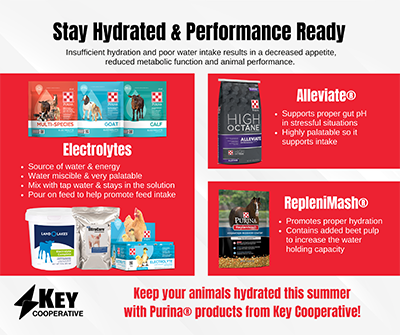
- Electrolytes
- Source of water and energy
- Very palatable - Can be poured on feed to help promote feed intake
- Water miscible - Can be mixed with tap water and stays in the solution
- Purina® Multi-Species Electrolyte for various young animal species including calves, foals, lambs and goat kids.
- Purina® Calf Electrolyte Supplement for calves from two days of age until weaning.
- Purina® Goat Electrolyte Supplement for kids and weaned/adult goats.
- LAND O LAKES® Electrolyte Complete for calves, foals, kid goats, lambs, pigs, deer, llamas, and alpacas.
- Purina® UltraCare® Swine Electrolyte for weaned pigs.
- Purina® Chick Electrolyte for poultry.
- Alleviate®
- Supports proper gut pH in stressful situations.
- Highly palatable so it supports intake.
- Purina® High Octane ALLEVIATE® Gastric Support Supplement for show cattle, pigs, lambs and goats.
- RepleniMash®
- Promotes proper hydration.
- Contains added beet pulp to increase the water holding capacity.
- Purina® RepleniMash® Product for horses.
Click graphic to view.
Contact our feed specialists to learn more about hydration products and how to keep your animals in champion shape for the state fair!
Ceara Smothers | Lifestyle Feeds Sales Specialist | Jasper, Mahaska & Poweshiek Counties | 641-260-6179
Kelcie Bohning | Key Cooperative, Gilbert Location | Boone, Polk & Story Counties | 515-232-6515
Brooke Gifford | Lifestyle Feeds Sales Specialist | Marshall & Tama Counties | 641-888-0818