A Dream to Farm
May 20, 2025
Sara Clausen
Director of Communications
ON JULY 2, 1951, the SS Washington—known for her regular route from New York to Hamburg—came into Ellis Island carrying Herbert and Kaethe Meyer and their family. Ellis Island is known for once being the busiest immigrant inspection and processing station in the United States. It’s also known for being the beginning of many American dreams. As one of more than 12 million immigrants who passed through the island, Herbert had a dream to farm.
At that time, an immigrant family was required to have a sponsor to relocate to the U.S. Thankfully, Herbert’s second cousin, Bill Cordes, welcomed them to Guernsey, Iowa—prime farm country. Later settling in Montezuma, the Meyers’ farm story began.
“I was drafted for the Vietnam War,” said Uwe Meyer, Herbert’s son. “After the war, I wanted to come back and farm.”
The farm started very small, but over the years Uwe added acres and then livestock. In 1996, his son, Jason, joined the farm operation. After Jason graduated from college with an ag marketing degree, the family took off on the hunt for even more land to own or rent. “I’m a first-generation farmer born in America,” said Jason. “Many around here have the opposite story!”
As the acres and number of calves grew, so did the family. Jason and Jodi have four children, who all play a role in the operation throughout the year. “Depending on the season, we could have up to 10 people working here,” said Jason. “This now includes my brother-in-law, Elliott.”
A Minnesota native, Elliott grew up in the dairy industry and was hoping to work with livestock. In fact, shortly after he married into the family, Uwe invited Elliott to be part owner of the cattle operation. Today, the Meyer family operation includes well over 500 animals
within a 12-mile radius. With more than 250 cow/calf pairs on pasture, spring requires an intense commitment to calving. “Herd genetics have come a long way,” said Elliott. “We now raise mostly Angus and Gelbvieh cross.”
The operation partners with Key Cooperative for their mineral and creep feed products. It is a relationship that also dates back generations. Jason was a neighbor and childhood friend of Key Feed Division Manager Matt James. “The Meyer family is hardworking, and they are a testament to the American dream,” said Matt. “They are also heavily involved in their community and give back in many ways.”
Uwe has served as the American Legion treasurer for as long as he can remember, and Jason is the current school board president (following many years as a board member). “We’re very supportive of the Montezuma FFA chapter and other industry organizations, such as the Iowa Soybean Association, the Iowa Corn Growers Association, the Poweshiek County Extension and the Poweshiek Cattlemen,” said Jason.
For the Meyer family, celebrating Beef Month in May aligns perfectly with their goals of bringing new calves into the world. “Beef is important to Iowa’s economy,” said Jason. “It gives us a great reason to celebrate!”
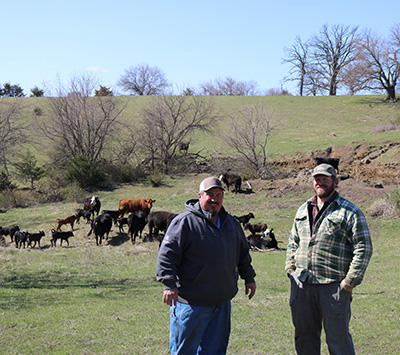
Pictured above: Jason Meyer (left) and his son-in-law, Elliott Scheck, on their cattle operation near Montezuma. They have well over 500 animals, raising mostly Angus and Gelbvieh cross.
Director of Communications
Celebrating Beef Month with the Meyer cattle operation
ON JULY 2, 1951, the SS Washington—known for her regular route from New York to Hamburg—came into Ellis Island carrying Herbert and Kaethe Meyer and their family. Ellis Island is known for once being the busiest immigrant inspection and processing station in the United States. It’s also known for being the beginning of many American dreams. As one of more than 12 million immigrants who passed through the island, Herbert had a dream to farm.
At that time, an immigrant family was required to have a sponsor to relocate to the U.S. Thankfully, Herbert’s second cousin, Bill Cordes, welcomed them to Guernsey, Iowa—prime farm country. Later settling in Montezuma, the Meyers’ farm story began.
“I was drafted for the Vietnam War,” said Uwe Meyer, Herbert’s son. “After the war, I wanted to come back and farm.”
The farm started very small, but over the years Uwe added acres and then livestock. In 1996, his son, Jason, joined the farm operation. After Jason graduated from college with an ag marketing degree, the family took off on the hunt for even more land to own or rent. “I’m a first-generation farmer born in America,” said Jason. “Many around here have the opposite story!”
As the acres and number of calves grew, so did the family. Jason and Jodi have four children, who all play a role in the operation throughout the year. “Depending on the season, we could have up to 10 people working here,” said Jason. “This now includes my brother-in-law, Elliott.”
A Minnesota native, Elliott grew up in the dairy industry and was hoping to work with livestock. In fact, shortly after he married into the family, Uwe invited Elliott to be part owner of the cattle operation. Today, the Meyer family operation includes well over 500 animals
within a 12-mile radius. With more than 250 cow/calf pairs on pasture, spring requires an intense commitment to calving. “Herd genetics have come a long way,” said Elliott. “We now raise mostly Angus and Gelbvieh cross.”
The operation partners with Key Cooperative for their mineral and creep feed products. It is a relationship that also dates back generations. Jason was a neighbor and childhood friend of Key Feed Division Manager Matt James. “The Meyer family is hardworking, and they are a testament to the American dream,” said Matt. “They are also heavily involved in their community and give back in many ways.”
Uwe has served as the American Legion treasurer for as long as he can remember, and Jason is the current school board president (following many years as a board member). “We’re very supportive of the Montezuma FFA chapter and other industry organizations, such as the Iowa Soybean Association, the Iowa Corn Growers Association, the Poweshiek County Extension and the Poweshiek Cattlemen,” said Jason.
For the Meyer family, celebrating Beef Month in May aligns perfectly with their goals of bringing new calves into the world. “Beef is important to Iowa’s economy,” said Jason. “It gives us a great reason to celebrate!”
Pictured above: Jason Meyer (left) and his son-in-law, Elliott Scheck, on their cattle operation near Montezuma. They have well over 500 animals, raising mostly Angus and Gelbvieh cross.