Cover Crops in Action
Dec 01, 2025
Landon Van Dyke
Conservation Agronomist
Earlier than average harvesting paired with warm fall temperatures has resulted in tremendous cover crop growth this fall. While it may seem like we won't get a fall like this again, historical weather data suggests it may be more likely than we think. Four out of the past five falls have gotten above average GDD (growing degree days) accumulation. 2015 and 2016 had similar GDDs and if we look back farther, we see that 2005 and 2007 were in the same number range as well. Most of the other years achieved enough GDDs to incur positive growth of cover crops.
While we don't know what future fall GDDs will be, we can use this information and experience to make necessary adjustments each season to maximize cover crop growth before killing frosts.
Here are a few of our cover crop success stories from this fall and their growth progression.
Grinnell
Drilled rye and brassica mix mid-September on cornstalks.

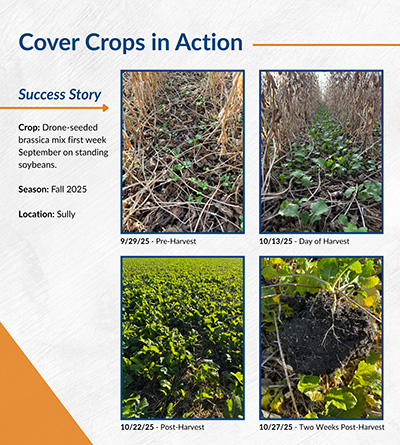
Sully
Drone-seeded brassica mix first week September on standing soybeans.
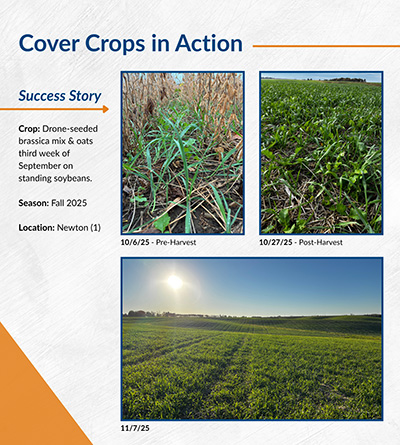
Newton 1
Drone-seeded brassica mix and oats third week of September on standing soybeans.
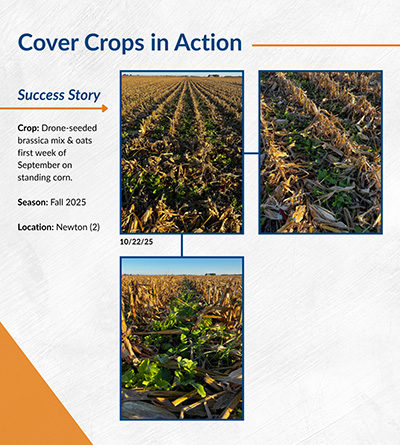
Newton 2
Drone-seeded brassica mix and oats first week of September on standing corn.
Next Season
Now is the time to plan your cover crops for next year! Contact Conservation Agronomist Landon Van Dyke at 641-260-2103 to get started.
Conservation Agronomist
Earlier than average harvesting paired with warm fall temperatures has resulted in tremendous cover crop growth this fall. While it may seem like we won't get a fall like this again, historical weather data suggests it may be more likely than we think. Four out of the past five falls have gotten above average GDD (growing degree days) accumulation. 2015 and 2016 had similar GDDs and if we look back farther, we see that 2005 and 2007 were in the same number range as well. Most of the other years achieved enough GDDs to incur positive growth of cover crops.
While we don't know what future fall GDDs will be, we can use this information and experience to make necessary adjustments each season to maximize cover crop growth before killing frosts.
Here are a few of our cover crop success stories from this fall and their growth progression.
Grinnell
Drilled rye and brassica mix mid-September on cornstalks.
Sully
Drone-seeded brassica mix first week September on standing soybeans.
Newton 1
Drone-seeded brassica mix and oats third week of September on standing soybeans.
Newton 2
Drone-seeded brassica mix and oats first week of September on standing corn.
Next Season
Now is the time to plan your cover crops for next year! Contact Conservation Agronomist Landon Van Dyke at 641-260-2103 to get started.