What Octane Ratings Really Mean for Your Car
Jun 01, 2026
Article courtesy of Cenex.com, written by Cassie Reule
Load up the snacks and crank up the tunes, because summer road trip season is approaching. Before you hit the open road, make sure you’re using a fuel that’s been engineered to meet your vehicle’s needs.
When you’re at the gas pump, you’ll see multiple grades of fuel to choose from. Fuel grades are determined by their octane rating. Many people assume a higher-octane gasoline will automatically give their vehicle better mileage or more power, but that isn’t necessarily the case. So, what do octane ratings at the pump really mean?
Why octane ratings matter for your engine
Gasoline-powered motors work by igniting a mixture of air and fuel at carefully timed intervals with a spark plug. Prior to each combustion, this air-fuel mixture is compressed, allowing its maximum energy potential to be extracted.
Determined by two testing methods, an octane rating is simply a measure of how heat-resistant a fuel is in order to prevent knocking — when the air-fuel mixture combusts spontaneously instead of from the spark plug. In other words, octane prevents the air-fuel mixture inside an engine from igniting before it’s supposed to.
Which octane rating should you use?
While there are several factors like temperature and driving methods that affect a car’s octane requirements, you should always use at least the minimum octane rating recommended by your vehicle manufacturer. Using a lower-octane fuel than required can cause knocking and will prevent your vehicle from meeting its stated fuel economy. Over time, filling up with fuel that’s not up to your vehicle’s requirements can damage both your engine and emissions control system.
On the other hand, using a higher grade of gasoline than recommended by your owner’s manual can add to the cost of your fill-up. More often than not, the higher the octane, the higher the price per gallon of gasoline. Those gallons add up quickly at a few cents per additional octane point. Under normal conditions, the best octane to use is the one recommended by your owner’s manual.
No matter which octane level your vehicle requires, you can depend on Cenex® Top Tier™ detergent gasoline to fuel your summer road trips. With a multifunctional, industry-leading additive package that comes standard in every grade, Cenex gasoline gives you worry-free, fuel-efficient miles on the road.
Which octane ratings does Key Cooperative offer?
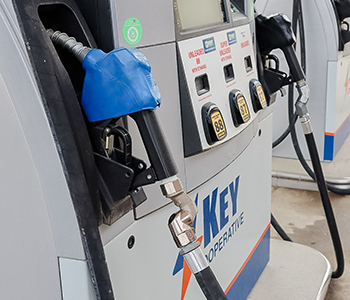
Key Cooperative offers Cenex® Top Tier™ gasoline products at all of our 24 - hour fuel stations. Our Super Unleaded has an octane rating of 87 and a 10% Ethanol blend. Our regular Unleaded gasoline also has an octane rating of 87 but contains 0% ethanol. Lastly, our newest gasoline product called Unleaded 88 (also known as E15) has on octane rating of 88 and a 15% ethanol blend.
Unleaded 88/E15 is available at the Key Cooperative 24-hour fuel stations in Nevada, Newton, Roland, Story City, Gilbert, Sully and coming soon to our new location in Zearing.